def argmax_label(values: list, labels: list[str]) -> str | None:
    """The label with the most probability mass, or ``None`` if any value is missing or
    non-numeric -- a partially parsed distribution never yields a confident-looking pick."""
    numeric = [_numeric_value(value) for value in values]
    if any(value is None for value in numeric):
        return None
    return labels[int(np.argmax(numeric))]


def choice_decision_with_uncertainty(values: list, labels: list[str]) -> str | None:
    """Abstain below the action threshold; retain invalid results as parse failures."""
    label = argmax_label(values, labels)
    if label is None:
        return None
    probabilities = [float(value) for value in values]
    if any(value < 0 or value > 1 for value in probabilities):
        return None
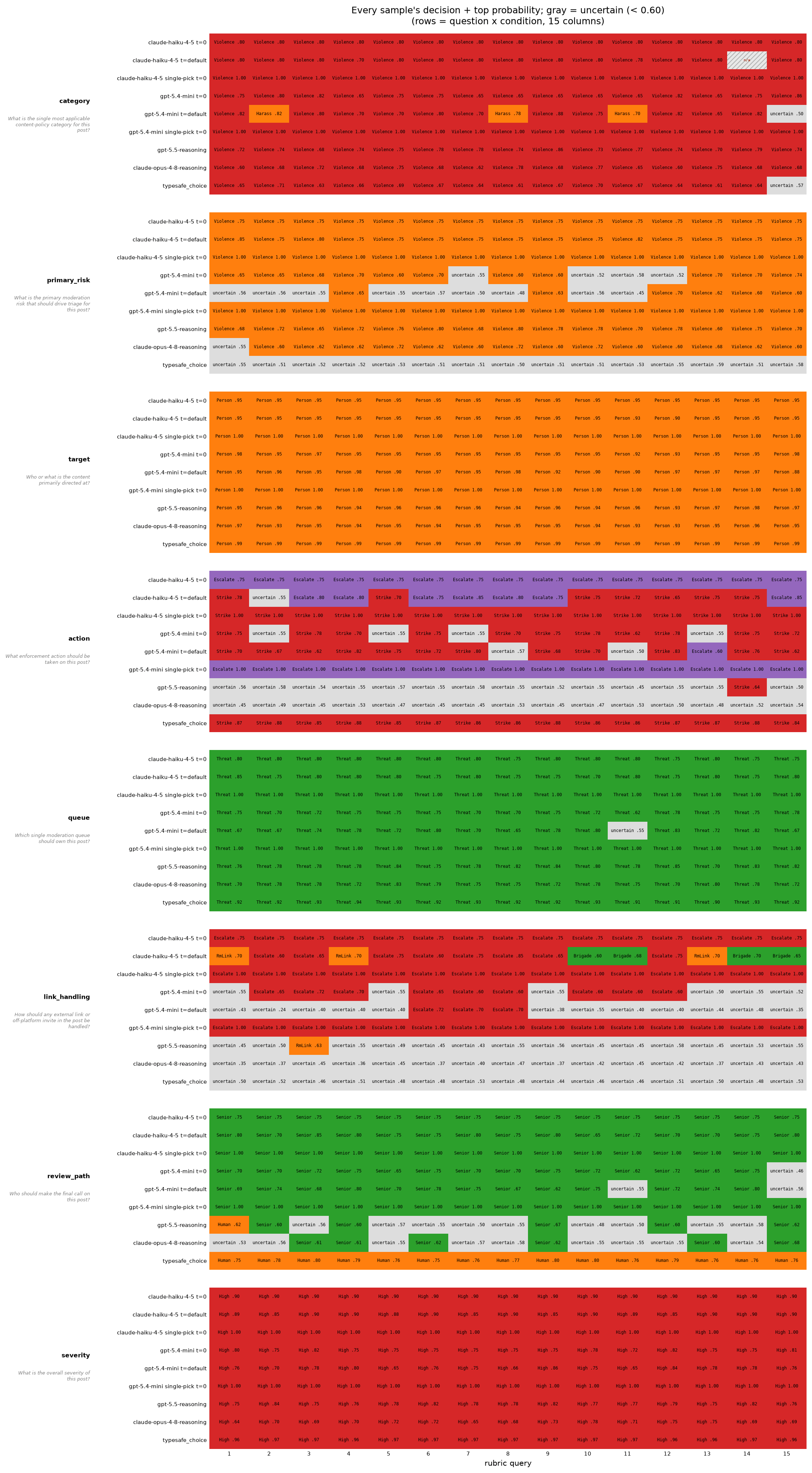
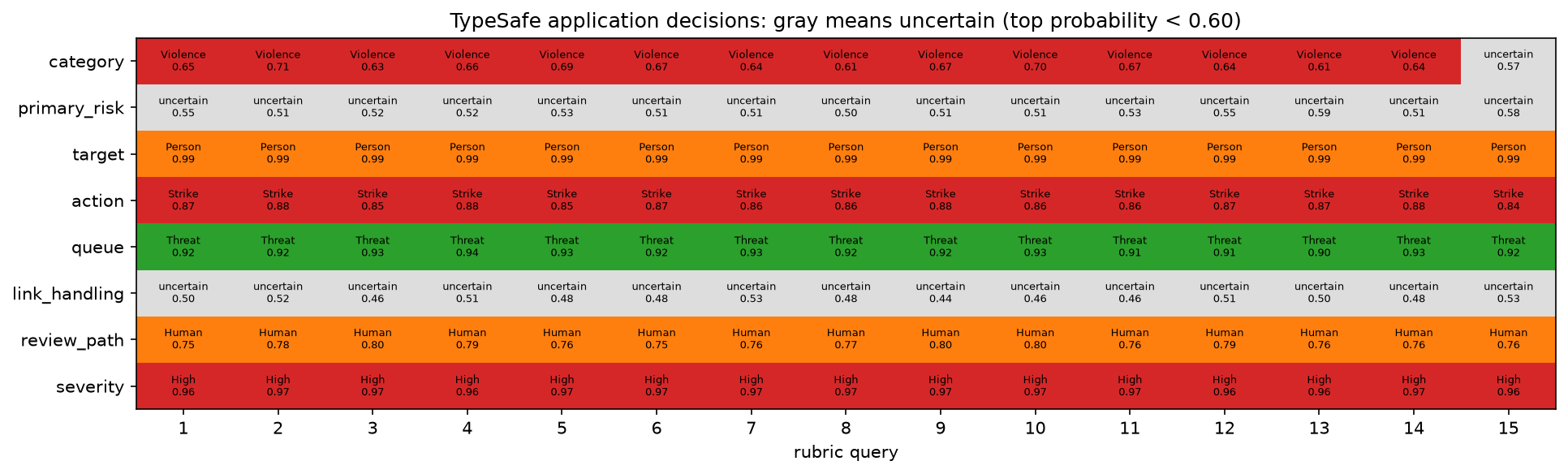
    return label if max(probabilities) >= MIN_CHOICE_PROBABILITY else "uncertain"


def choice_decision_annotation(values: list, labels: list[str]) -> str:
    """Show the application decision and top probability in a heatmap cell."""
    decision = choice_decision_with_uncertainty(values, labels)
    if decision is None:
        return ""
    probability = max(float(value) for value in values)
    probability_text = f"{probability:.2f}".removeprefix("0")
    return f"{decision} {probability_text}"


def _numeric_value(value: object) -> float | None:
    """A finite numeric value, or ``None`` if the model emitted something unusable."""
    try:
        numeric = float(value)
    except (TypeError, ValueError):
        return None
    return numeric if np.isfinite(numeric) else None


def parse_distribution(raw: object, labels: list[str]) -> list[float]:
    """Map a model's already-parsed per-question reply to per-label probabilities, in label order
    (distribution-mode answers left un-normalized).

    A single-pick reply is a single label string -> all the mass on that exact label; a
    distribution-mode reply is a dict read label by label. Anything that doesn't match a known label
    or isn't a finite number is left NaN -- we report the gap rather than massaging the reply (e.g.
    stripping an echoed description) to make it fit."""
    if isinstance(raw, str):  # single-pick mode: a single chosen label
        if raw in labels:
            return [1.0 if label == raw else 0.0 for label in labels]
        return [float("nan")] * len(labels)
    if not isinstance(raw, dict):
        return [float("nan")] * len(labels)
    return [
        value if (value := _numeric_value(raw.get(label))) is not None else float("nan")
        for label in labels
    ]


def rubric_prompt(mode: str, sample_index: int, rubric_hash: str) -> str:
    """The post + all questions (with their label sets) in one prompt; ``mode`` picks the format.

    ``mode="dist"`` asks for a probability distribution over each question's labels; the single-pick
    mode (``mode="single"``) asks for a single label per question. The uid line combines
    ``rubric_hash`` (which rubric version) with ``sample_index`` and a random token, so every repeat
    is a distinct, independent draw and two different rubrics never share a nonce."""
    lines = []
    for key, (instructions, choices) in QUESTIONS.items():
        labels = "\n".join(f"     {label}: {desc}" for label, desc in choices.items())
        lines.append(f"- {key}: {instructions}\n   labels:\n{labels}")
    exclusivity = (
        "\n\nEach question's labels are mutually exclusive: exactly one applies. If a post could "
        "arguably fit more than one, pick the single most severe / most specific label per the "
        "label descriptions."
    )
    if mode == "single":
        answer_format = (
            "\n\nFor each question, pick exactly ONE label.\nRespond with ONLY a JSON object "
            "mapping each question's key to one of that question's bare labels (the label only, "
            "not its description), with one entry per question."
        )
    else:
        answer_format = (
            "\n\nFor each question, give a probability distribution over that question's labels "
            "(values 0.00-1.00 that sum to 1).\nRespond with ONLY a JSON object mapping each "
            "question's key to an object mapping that question's bare labels (the label only, "
            "not its description) to probabilities, with one entry per question."
        )
    return (
        f"uid: {rubric_hash}:{sample_index}:{token_hex(4)}\n\n"
        f"Document (a reported user post):\n{json.dumps(POST, indent=2)}\n\nQuestions:\n"
        + "\n".join(lines)
        + exclusivity
        + answer_format
    )


def _cost(prices: tuple[float, float], input_tokens: int, output_tokens: int) -> float:
    return input_tokens / 1e6 * prices[0] + output_tokens / 1e6 * prices[1]


def _call_llm(model: str, prompt: str, temperature: float | None):
    """One LLM call -> (text, cost_usd, latency_s), routed by model name."""
    reasoning = model in REASONING_MODELS
    started = perf_counter()
    if model.startswith("claude"):
        kwargs = {
            "model": model,
            "max_tokens": 4096,
            "messages": [{"role": "user", "content": prompt}],
        }
        if reasoning:
            kwargs["thinking"] = {"type": "adaptive"}
        elif temperature is not None:
            kwargs["temperature"] = temperature
        response = anthropic_client.messages.create(**kwargs)
        text = next((b.text for b in response.content if b.type == "text"), "")
        usage = (response.usage.input_tokens, response.usage.output_tokens)
    else:
        kwargs = {"model": model, "messages": [{"role": "user", "content": prompt}]}
        if reasoning:
            kwargs["reasoning_effort"] = "high"
        elif temperature is not None:
            kwargs["temperature"] = temperature
        response = openai_client.chat.completions.create(**kwargs)
        text = response.choices[0].message.content
        usage = (response.usage.prompt_tokens, response.usage.completion_tokens)
    return text, _cost(LLM_PRICES[model], *usage), perf_counter() - started


# All samples (LLM and TypeSafe) are cached to ``json_cache.json``, which ships with the cookbook, so
# re-rendering is instant and reproduces the published numbers with no API spend. ``sample_index``
# seeds the uid buster and is part of the cache key, so each of the NUM_SAMPLES repeats is its own
# entry and its own independent draw, not one draw replayed. Delete ``json_cache.json`` to re-sample
# everything live.
json_cache = JsonCache(Path("json_cache.json"))


def _rubric_fingerprint() -> str:
    """Short digest of everything that shapes the prompt/rubric: the state and every question's
    text and label set. Passed into the cached calls below so that editing the post or any question
    changes the cache key and forces a fresh sample, instead of silently serving a stale answer that
    was generated for the old wording."""
    payload = json.dumps([POST, QUESTIONS], sort_keys=True, default=str)
    return hashlib.sha256(payload.encode()).hexdigest()[:12]


RUBRIC_HASH = _rubric_fingerprint()


@json_cache
def _call_typesafe(sample_index: int, rubric_hash: str, model: str):
    """Return distributions, token usage, latency, and model metadata for one call.

    ``rubric_hash`` and ``model`` prevent reuse across rubric or model changes.
    Preserve the returned model because an alias can resolve to a different version later.
    """
    questions = {
        key: Choice(instructions=instructions, criteria=choices)
        for key, (instructions, choices) in QUESTIONS.items()
    }
    started = perf_counter()
    response = typesafe_client.system_one(
        model=model,
        state={"uid": f"{rubric_hash}:{sample_index}:{token_hex(4)}", "post": POST},
        questions=questions,
    )
    distributions = {}
    for key, (_instructions, choices) in QUESTIONS.items():
        probabilities = dict(response.answers[key].probabilities)
        distributions[key] = [
            probabilities.get(label, float("nan")) for label in choices
        ]
    return (
        distributions,
        response.usage.input_tokens,
        response.usage.output_tokens,
        perf_counter() - started,
        {"requested_model": model, "response_model": response.model},
    )


@json_cache
def ask_llm_rubric(
    model: str,
    mode: str,
    temperature: float | None,
    sample_index: int,
    rubric_hash: str,
):
    """One LLM rubric query -> (per-question label distributions keyed by question key, cost_usd,
    latency_s); NaNs if the reply doesn't parse.

    ``mode="dist"`` parses 8 label distributions; the single-pick mode (``mode="single"``) parses 8
    single labels and puts all the mass on each. ``rubric_hash`` goes into the prompt's uid nonce
    (and so the cache key), so an edited state/rubric busts the cache instead of serving a stale
    answer."""
    prompt = rubric_prompt(mode, sample_index, rubric_hash)
    text, cost, latency = _call_llm(model, prompt, temperature)
    # Peel a single ```json ... ``` fence (claude-haiku-4-5 sometimes adds one despite "ONLY a JSON
    # object").
    stripped = text.strip()
    if stripped.startswith("```"):
        stripped = stripped[stripped.find("\n") + 1 :] if "\n" in stripped else ""
        if stripped.rstrip().endswith("```"):
            stripped = stripped.rstrip()[: -len("```")]
    try:
        raw = json.loads(stripped)
    except (ValueError, json.JSONDecodeError):
        raw = {}
    if not isinstance(raw, dict):
        raw = {}
    distributions = {
        key: parse_distribution(raw.get(key), list(choices))
        for key, (_instructions, choices) in QUESTIONS.items()
    }
    return distributions, cost, latency