

Try it yourself
Open this example in the TypeSafe PlaygroundHow do we find one document in thousands?
Checking every document against the query, one at a time, takes one comparison per document: millions of documents means millions of comparisons per query. Two steps are faster:- Cut the pile down to a short list of likely candidates, using a method fast enough to run on the whole pile.
- Apply a more accurate step to that short list, to find the exact right answer.

What is fast search?
Fast search is any method that can compare a query against every document in a large corpus and quickly return a ranked shortlist. Common methods include keyword search, such as BM25, and dense embeddings, which compare passages by meaning. The first step here is BM25 and nothing else. BM25 ranks passages by shared words. The choice of fast search method is a side issue: re-ranking only ever sees the passages that make the shortlist.What is re-ranking?
Re-ranking puts the shortlist in a better order. Instead of comparing the query against the whole corpus at once, it scores the query against each candidate on the shortlist and sorts by that score.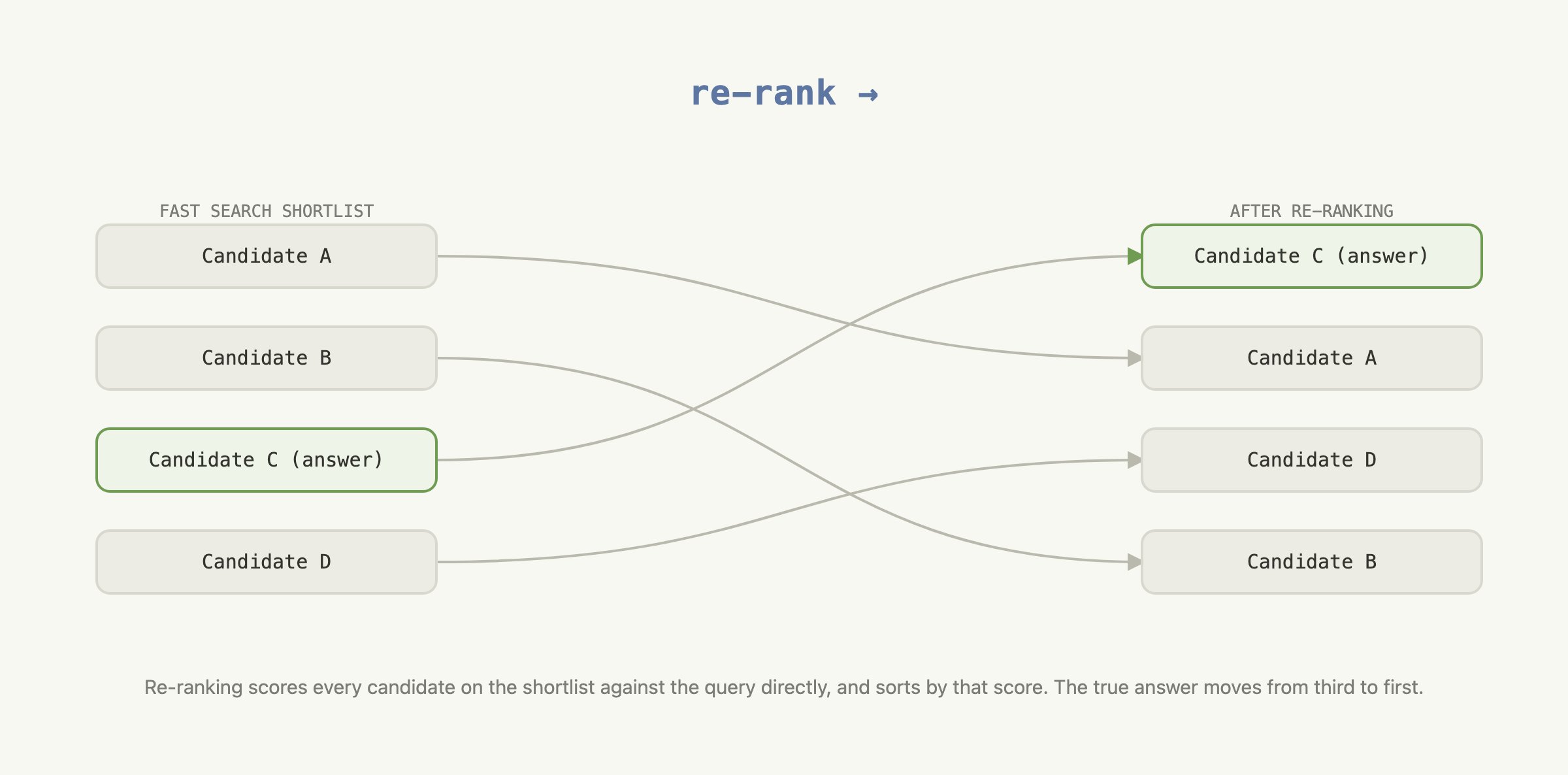
Re-ranking with TypeSafe
A re-ranker needs a comparable score for every query-candidate pair.What TypeSafe returns
With TypeSafe, the scoring request is a yes/no question:Noul instead
returns a number between 0 and 1, called a
noul. The noul is TypeSafe’s estimate
of how likely the answer is to be yes.
The question’s criteria define what counts as true and false. TypeSafe applies them to
every query-candidate pair and returns the noul directly. That noul is the score the
application sorts on.
In simplified pseudocode, one TypeSafe scoring call looks like this:
A re-ranking example
Fast search and re-ranking now run on CLERC, a legal retrieval dataset. This example uses 3,565 court opinion passages and 40 queries.Setup
bm25sanddatasetsbuild the fast search shortlist.typesafe-sdkandcooksafehandle re-ranking and API caching.matplotlibdraws the result charts.
json_cache.json from
typesafe-public-examples into the folder you run the script from.
Calling TypeSafe needs a TYPESAFE_API_KEY.
Ranking the passages with fast search
The dataset used here is a corpus of US court opinions, 170 rows pooled together. Each row breaks down like this:- Query: an opinion excerpt with a citation removed.
- Gold: the passage the removed citation pointed to, the one correct answer to the query.
- Candidates: every other passage in the corpus, each one something the query could be matched against by mistake.
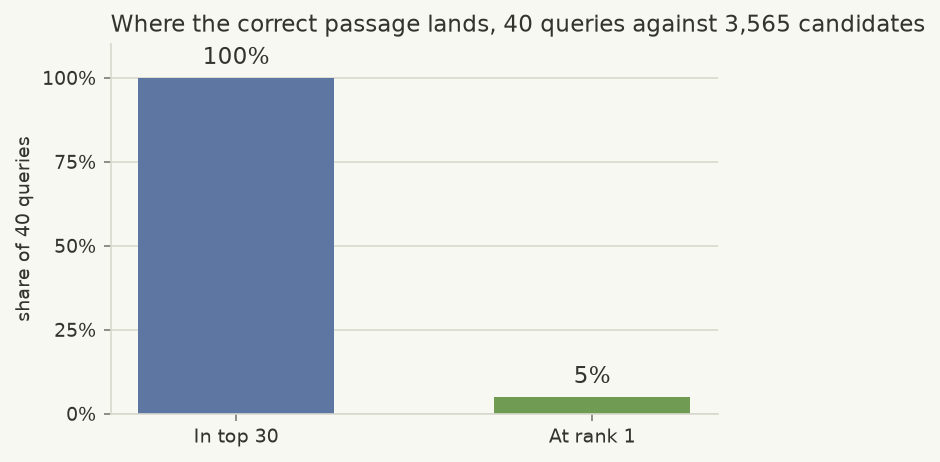
Fast search is unlikely to rank the right passage first
The chart shows where fast search puts the correct passage, out of 3,565 candidates. The shortlist contains the right answer for 100% of the 40 queries, but ranks it first only 5% of the time. Re-ranking only reorders the top 30 candidates already on the shortlist. It cannot add a passage that fast search did not select.Re-ranking the shortlist with TypeSafe
The question TypeSafe asks about each pair is whether the candidate could be the passage the query’s removed citation points to. Re-ranking takes three steps:- Define that question.
- Ask it once per candidate on every shortlist: 40 queries times 30 candidates, or 1,200 calls, run concurrently.
- Sort each shortlist by the noul TypeSafe returns.
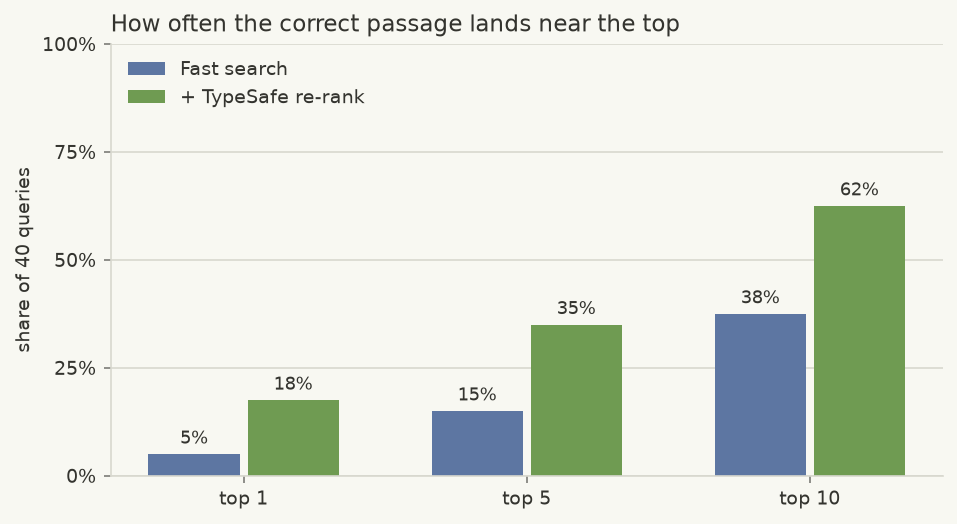
Re-ranking moves the right answer toward the top
The chart compares fast search against fast search plus re-ranking, at three thresholds. Re-ranking moves the correct passage closer to the top at every one of them:- Top 1: 5% → 18%
- Top 5: 15% → 35%
- Top 10: 38% → 62%
What’s next
- Noul, for how TypeSafe turns a yes/no question into a score.
- Speculative Fan-Out, for asking several questions about one document in a single call.
- Line-by-line Search, for another way to search a corpus by meaning rather than keywords.